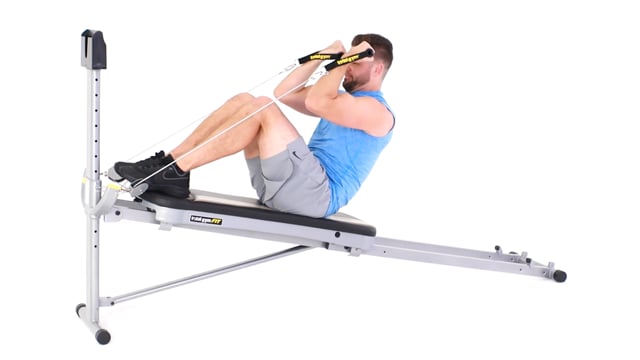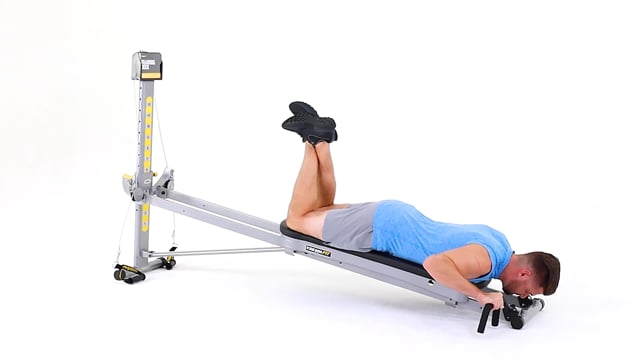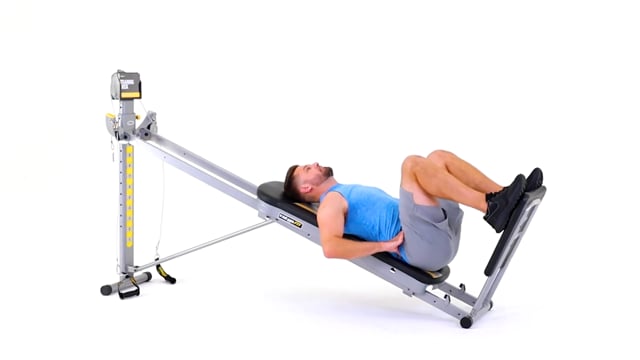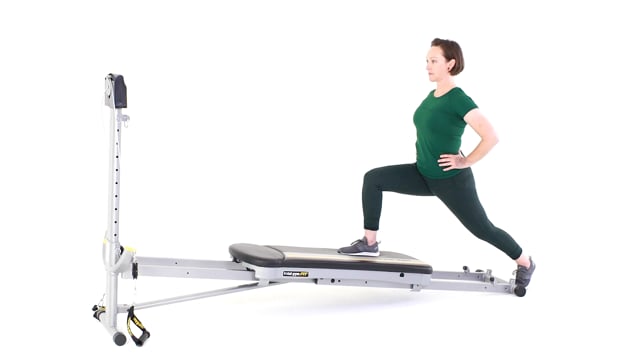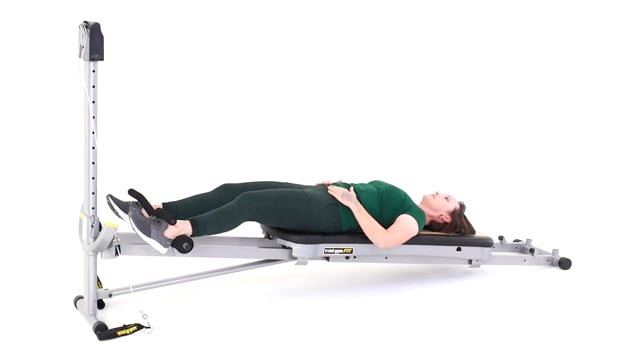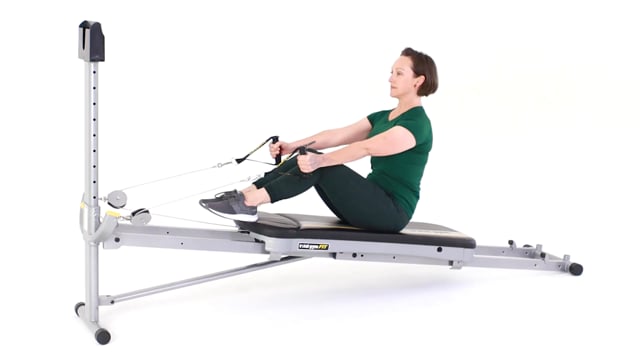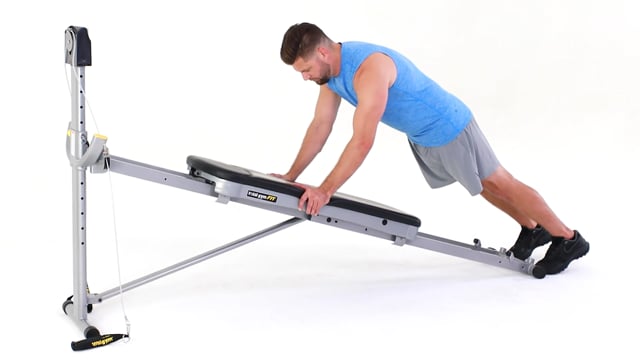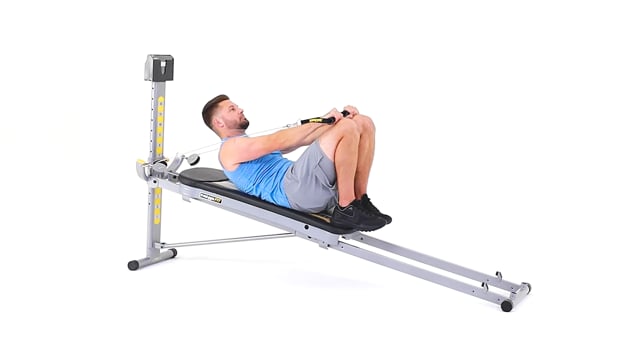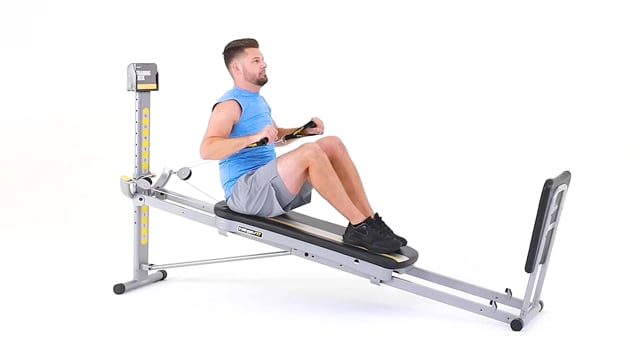
Every rep is one fluid glide — your stabilizers never switch off.
You set the resistance
GentleIntense
Lvl4
BW10%
Lbs19
Best forRehab & mobility
*Based on 16 levels of resistance (cable pulley attached), U.S. average adult weight (190 lbs.) and rounded to the nearest whole %/lb.
Upper Body
Six Demonstrations
Bicep Curl
Arms
Anchor on the cable system while seated or kneeling on the glideboard. Keep elbows pinned and curl with control — same isolation, none of the spinal load of a barbell.
The classic pulldown, redirected through overhead pulleys. Drive through the elbows to engage your lats — your bodyweight provides the resistance, no stack required.
Press upward while the glideboard stabilizes your spine. Core stays engaged, shoulders do the work — a safer pressing pattern for anyone wary of overhead loading.
Cables isolate the triceps with low-impact resistance. Elbows tucked, full extension at the top — clean isolation work without the elbow strain of skull crushers.
Lie back on the glideboard and arc the cables out and across. A slight bend at the elbow, a deliberate squeeze at the top — pec engagement without dumbbells dropping toward your face.
Pull through the elbows, draw the shoulder blades together, keep the chest lifted. The mid-back gets the work that desk life keeps trying to take from it.
Plant your feet on the squat platform and drive through the heels. Knees track over the toes, glideboard supports the descent — squat depth without the spinal compression.
Hamstrings carry the load through a slow, controlled glide. The kind of isolation work that's hard to replicate at home without a dedicated leg curl machine.
Cable resistance plus glideboard travel equals smooth, low-impact hamstring work. Ideal for anyone rehabbing knees or building posterior-chain strength carefully.
A side-by-side look at how bodyweight resistance on a glideboard compares to free weights and a traditional cable machine — across the dimensions that actually matter at home.
Home strength training compared
Total Gym
Free Weights
Cable Machine
Resistance Source
Body weight + incline
External plates / dumbbells
Weight stack
Joint Impact
Low — supported movement
Higher — depends on form
Low to moderate
Footprint (Folded)
Slides under most beds
Rack + plates required
Permanent installation
Exercises Possible
200+
Hundreds, with full kit
40–60
Beginner Friendly
Very — guided support built in
Steep learning curve
Moderate
Used in Rehab
Yes — widely
Rarely
Sometimes
Stabilization Demand
Built-in core engagement
High — you provide it
Low to moderate
The Experience
Why it feels different from lifting weights.
A Total Gym workout doesn’t replicate the gym — it improves on a few of its weaker points. The difference shows up most in the joints, the learning curve, and the consistency of resistance through each rep.
Smooth, continuous resistance
Free weights have sticking points — angles where the load drops off and the muscle gets a break. Glideboard resistance stays smooth and consistent through the entire range of motion.
Less stress on joints, tendons, and ligaments
Low-impact movement throughout every rep
More time under tension, which drives results
No dropped weights, no spotter required
Beginner-friendly. Built for every level.
Total Gym is one of the most approachable strength tools you can buy. Start at the lowest incline, learn the movement patterns with the glideboard supporting your form, and progress one notch at a time as you get stronger.
Start at 4–8% body weight and build up
Widely used in physical therapy and rehab
Scales from rehabilitation to advanced training
Same machine grows with you for years
Ready to start
Bring the gym home.
30-day risk-free trial · Free shipping · Starts at $1